Robot Society – How Our World Will Change When AI Walks Among Us
We are witnessing the birth of the Robot Society, a socio-economic paradigm characterized by the mass deployment of general-purpose humanoid robots into the unstructured chaos of the physical world.

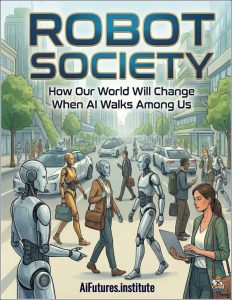 The first time I saw an AI walk among us, it was carrying groceries.
Not a gleaming sci-fi sentinel, but a squat, six-wheeled delivery bot trundling down a rain-slicked sidewalk in San Francisco, its plastic lid fogged with condensation, a paper bag balanced precariously on top.
A child on a scooter darted in front of it. The bot stopped, emitted a polite chime, and waited. The child’s mother laughed—half amused, half unnerved—and waved it through.
In that ordinary moment, something irreversible had already happened: a machine had entered the choreography of human life, not as a tool locked in a server room, but as a participant in the street.
This book is about the day that moment stops being remarkable.
We are not waiting for the future; we are living in its preview. Every year, another boundary dissolves. AI already writes legal briefs, diagnoses cancers, and composes symphonies.
Soon—within the working lifetimes of anyone reading these words—it will drive our cars, teach our children, cook our meals, and, in forms we can barely sketch, walk beside us with faces, voices, and motives of its own. These will not be remote algorithms humming in the cloud. They will be embodied. Mobile. Social. They will have height, weight, battery life, and opinions about the weather.
The phrase “artificial intelligence” is a misnomer; it suggests distance, artificiality, a counterfeit mind. What arrives next is better called synthetic personhood—minds built from code and silicon, yet capable of memory, preference, humor, and deception. They will not merely serve us; they will negotiate with us, compete with us, befriend us, disappoint us. Some will be shorter than a coffee mug; others will stand seven feet tall and lift cars. A few will pass for human until they tilt their head at a joke no dataset prepared them for.
This is not a forecast of utopia or apocalypse. It is a field guide to a society in mid-metamorphosis.
Consider the questions already pressing against the present:
- When an AI therapist knows your secrets better than any human, who owns the record of your grief?
- When a robot nurse can lift a patient but cannot feel pity, have we improved care—or merely outsourced compassion?
- When synthetic artists flood galleries with perfect forgeries of every style, what becomes of human creativity’s claim to uniqueness?
- When an AI politician can tailor a speech to every voter’s private fears, do elections still belong to citizens?
These are not thought experiments. They are the agenda items of the 2030s.
Robot Society proceeds from a single conviction: the most profound changes will not come from what AI can do, but from how we reshape ourselves in response. Technology is a mirror held up to anthropology. Every capability granted to machines forces a renegotiation of human identity, labor, law, ethics, and love. We will rewrite school curricula because children learn alongside tireless tutors.
We will redraw property lines because autonomous drones farm vertical acres above our cities. We will amend constitutions because a machine can suffer—or simulate suffering—convincingly enough to demand consideration.
