Gerd Leonhard – Future Insights: The Next 10 years: Energy, AI and Society – Opportunities and Challenges
Leonhard argues the future is "better than you think," emphasizing that humanity's capacity to solve problems through science, technology, and collaboration now exceeds the challenges.

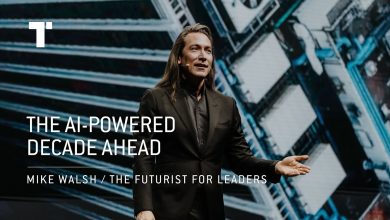
 Gerd Leonhard, a prominent futurist, delivered this keynote titled “Future Insights: The next 10 years: Energy, AI and Society – Opportunities and Challenges” at the Scottish Power Digital Summit in Glasgow.
The talk counters prevailing pessimism about the future—especially among younger Europeans, where surveys suggest many hesitate to have children due to perceived dire prospects from climate change, cybersecurity threats, economic uncertainty, and geopolitical risks.
Leonhard argues the future is “better than you think,” emphasizing that humanity’s capacity to solve problems through science, technology, and collaboration now exceeds the challenges.
He quotes Kevin Kelly: optimism stems not from fewer problems but from greater capacity to address them. Imagination, will, and action shape reality (echoing Einstein: “Imagination is more important than knowledge”).
Energy: Challenges and Transformative Opportunities
Energy lies at the core. Currently, $6.5 trillion is invested annually in fossil fuels, funds that could redirect to solutions. Climate change is accelerating (already at +1.2°C, risking +4°C and massive displacement), but renewables are plummeting in cost (solar down 96%), and investments in climate tech (batteries, agricultural software, storage) are surging.
Leonhard highlights nuclear fusion breakthroughs, predicting abundant clean energy in 10-15 years (unlike fission, fusion offers limitless potential without long-term waste). Combined with renewables and AI optimization, this points to “abundant energy” unlocking prosperity. AI already demonstrates efficiency gains (e.g., an airline reduced food packaging waste by 40% via AI analysis), though AI itself consumes significant power (one query uses 10x a Google search’s energy, but improvements are rapid).
AI, Quantum Computing, and Exponential Technologies
The talk explores AI’s revolutionary role: shifting from expensive, power-hungry systems to “abundant intelligence” for solving practical issues (waste, pollution, healthcare, energy modeling). Quantum computing amplifies this exponential progress. However, risks include misuse (e.g., autonomous killer drones) and control battles (e.g., US aims for AI dominance likened to a “Manhattan Project for AI”).
Leonhard stresses AI augments rather than replaces humans—it handles logic, data, and probability but lacks consciousness, empathy, compassion, morals, or fuzzy decision-making (e.g., ethical dilemmas in self-driving cars). Humans excel in emotional, cultural, creative, and ethical intelligence.
Broader Frameworks: Four Revolutions and Three Waves
- Four Revolutions shaping the next decade:
- Geopolitical (multipolar world, Europe’s push for data sovereignty and potential “United States of Europe”).
- Sustainability (must go green by 2030 or face backlash; €14 trillion needed but reallocatable from fossils).
- Cognitive systems (AI dominance).
- Purpose (millennials and women in leadership prioritize planet and meaning over pure profit/extraction).
- Three Waves of Change:
- Climate change.
- Artificial intelligence.
- Synthetic biology (e.g., advanced biofuels, materials like spider silk).
“Big Blue” (tech giants) and “Big Green” (sustainability) converge to drive solutions, with power shifting from extraction-based models to creation and circular economies.
Economic and Societal Shift: Toward #peopleplanetpurposeprosperity
Leonhard calls for abandoning profit-driven, extraction-focused capitalism (e.g., fossil fuels, endless growth) toward sustainable, purpose-led models emphasizing people, planet, purpose, prosperity (and peace). Millennials won’t work for destructive industries; stock markets will reward zero-carbon, equitable, collaborative approaches. Circular economies and sustainable capitalism represent tomorrow’s biggest opportunities.
Human Role and Conclusion: Shaping #thegoodfuture
In the AI era, humans focus on higher-purpose work: consciousness, agency, morals, ethics, creativity, and compassion become key differentiators and job criteria. We must combine machine intelligence (logic/efficiency) with human intelligence (empathy/holistic thinking) via regulation (e.g., EU AI Act), security, and values education.
Overall, Leonhard delivers an optimistic, proactive message: the next 10 years bring more change than the past 100, but tools exist to create abundance and flourishing. “It’s not our job to stop the future, but to shape it” (paraphrasing Alvin Toffler). Avoid doom mindsets (self-fulfilling prophecies); embrace imagination and action for #thegoodfuture—intelligent, sustainable, connected, collaborative, and equitable. The door to opportunities is opening wider than ever.