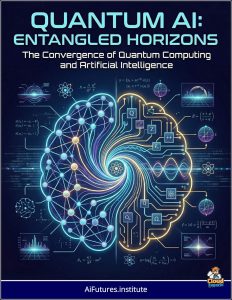
 Imagine computers that don’t just get faster—they start thinking in entirely new ways.
That’s what happens when artificial intelligence (AI) joins forces with quantum computing.
In 2026, these two powerful technologies are teaming up, creating machines that can solve problems once thought impossible. This isn’t sci-fi. It’s happening now, and it could change medicine, energy, transportation, and daily life in big ways.
The central idea are ‘Qubits‘.
Think of a regular computer bit as a light switch: it can only be ON (1) or OFF (0). That’s it. Every number, photo, video, or AI calculation in your phone or laptop is built from billions of these simple 0s and 1s.
A qubit (short for quantum bit) is different—and much more powerful. It’s like a spinning coin that can be both heads and tails at the same time until you look at it.
Why This Matters: Classical Computers Are Hitting Limits
Regular computers and today’s AI systems are incredibly smart, but they’re reaching their limits. Training a large AI model uses massive amounts of electricity—sometimes as much as a small city. Many real-world problems, like finding the best routes for thousands of delivery trucks or designing new medicines, are too complex for even the biggest supercomputers to handle efficiently.
Quantum computers work differently. Instead of regular “bits” that are either 0 or 1, they use “qubits” that can be both 0 and 1 at the same time (a concept called superposition). They can also link together through entanglement, allowing them to explore many possibilities all at once. This gives them a special kind of power for certain tough tasks.
The real breakthrough is the hybrid approach: Quantum computers handle the hard, specialized parts, while regular computers and AI manage the rest. AI even helps improve the quantum hardware by fixing errors and optimizing how it runs.
What’s Happening Right Now (2025–2026)
We’re moving from lab experiments to real-world use:
- In Finance: Banks have tested quantum systems that make better predictions for stock trades, showing noticeable improvements over traditional methods.
- In Medicine: Researchers are using quantum tools to study complex proteins and molecules. This speeds up the search for new drugs, especially for diseases that have been hard to treat.
- In Logistics: Companies like Volkswagen and BMW have used early quantum systems to optimize traffic flow and supply chains, saving time, fuel, and costs.
Big players like IBM (with their Heron quantum chips), Google, and NVIDIA are building better hardware. AI software now helps control these delicate quantum machines, making them more reliable and useful for businesses.
How This Changes Everything: The Big Impacts
This combination unlocks three major areas:
Faster Scientific Discoveries: Quantum computers can simulate molecules and materials at the atomic level in ways regular computers can’t. Paired with AI, this could lead to better batteries, new clean energy materials, and quicker medical breakthroughs.
Smarter Optimization: Problems with too many possible combinations—like scheduling flights, managing global supply chains, or investing money—become easier. Hybrid systems find better solutions faster, which could reduce waste and lower emissions.
Better AI: Quantum tech can help AI models learn from less data, generate more creative ideas, and run more efficiently. Future AI might need far less electricity while becoming even more capable.
The Challenges We Still Face
It’s not all smooth sailing. Quantum bits are very fragile—they lose their special properties quickly due to tiny disturbances (called decoherence). Keeping them stable requires extremely cold temperatures and careful control.
Error correction is improving, thanks in part to AI, but fully reliable “fault-tolerant” quantum computers are still a few years away. The systems are also expensive and mostly available through cloud services for now.
Other concerns include:
- Cybersecurity: Quantum computers could eventually break current encryption, so experts are racing to create new, safer codes.
- Energy use: Both AI and quantum cooling need power, so sustainable growth matters.
- Society: More powerful AI raises questions about jobs, fairness, privacy, and responsible use.
Looking Ahead: A New Kind of Intelligence
By the late 2020s and beyond, we could see quantum processors deeply integrated into AI systems. This might create machines that reason in probabilities and explore possibilities more like nature itself does.
The economic impact is expected to grow quickly, but the real value will come from solving problems we struggle with today—from climate change to personalized medicine.
The Bottom Line
The merging of quantum computing and AI isn’t just about making computers faster. It’s about creating machines that think differently and tackle challenges in brand-new ways. This convergence could help us design life-saving drugs, build a cleaner world, and unlock scientific mysteries.
The technology is advancing rapidly. The key question is: How will we guide it? If developed thoughtfully, quantum-AI could become one of the most positive forces for human progress in the 21st century. The future of smarter machines is arriving—and it’s full of exciting possibilities.