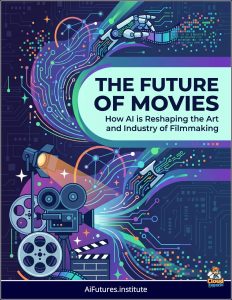
 We are currently witnessing a transformation in how we consume and create cinema, one that blurs the line between the archival past and the generative future.
For many, the first encounter with “New Hollywood” arrives with a sense of relatable curiosity: seeing a young Tom Hanks in his prime or hearing the unmistakable, booming bass of James Earl Jones’s Darth Vader.
However, this technological leap exists in a state of high tension. On one side is the industry’s dread of “AI slop”—uninspired, low-quality content that threatens to saturate the market.
On the other are massive leaps in creative efficiency that allow storytellers to bridge the gap between imagination and reality. Are we entering a grim era of “digital necromancy,” where the dead are perpetually recycled for profit, or a new golden age of creative efficiency?
Takeaway 1: The End of the “Text-Only” Script
The traditional barrier between the writer’s room and the production office is dissolving. Platforms like LTX Studio are spearheading a shift toward a “script-to-screen” workflow where writing is no longer just about words on a page; it is about instant visualization.
By merging screenwriting with cinematic video generation, these tools allow creators to develop concepts, storyboards, and sequences simultaneously. This encourages a “visual mindset” that eliminates the traditional delay between a writer’s words and a director’s vision.
However, from a strategist’s perspective, a significant hurdle remains: LTX Studio does not yet integrate traditional screenplay formatting standards. This means that while it is a revolutionary tool for ideation, it currently sits outside the union-standard pipeline required for professional Hollywood submissions.
“LTX Studio… encourages writers to develop a visual mindset, bridging the divide between text on the page and cinematic storytelling.”
Takeaway 2: California’s New Legal “Shield” for Performers
As technology makes it easier to replicate human likeness, the legal landscape is finally erecting a defensive perimeter. Effective January 1, 2025, California has enacted two landmark bills, AB 1836 and AB 2602, to protect the “Digital Replica” of performers. This term refers to computer-generated, highly realistic representations of an individual’s voice or likeness in works where they did not actually perform.
The strategist must note that these laws specifically target substitution—the use of AI to replace a live human. They do not prohibit the use of non-generative AI to finish or refine a performance, such as digital remastering or “cleanup” authorized by a copyright holder.
Core Protections under the New Laws:
- Substitution Consent: AB 2602 renders contractual provisions unenforceable if they allow a digital replica to be used as a substitute for work a performer would have otherwise done in person, unless specific informed consent is given.
- Professional Representation: Contracts involving digital replicas are void if the performer was not represented by legal counsel or a labor union.
- Post-Mortem Control: AB 1836 gives estates the power to block the unauthorized commercial use of a deceased performer’s likeness, ending the era where a studio might assume they “own” a person’s ghost. For instance, if Pepsi wanted to recreate a young Michael Jackson for a new commercial, the MJ estate now holds the “kill switch.”
Takeaway 3: The “Digital Will” of James Earl Jones
The passing of James Earl Jones in 2024 highlighted a new kind of “cinematic organ donation.” Jones explicitly authorized the AI recreation of Darth Vader’s voice, a move that stands in stark contrast to the 2016 use of Peter Cushing’s likeness in Rogue One.
From an ethicist’s view, the Cushing case remains a cautionary tale: Disney initially believed they didn’t even need to contact Cushing’s estate, assuming his 1977 contract covered digital resurrection. When you consider that Jones was originally paid a mere $7,000 to voice Vader, the commodification of a performer’s legacy for a multi-billion-dollar franchise becomes even more troubling. Jones’s “digital will” provides a roadmap for consent, but it also raises the question: just because we can maintain a brand through a digital replica, should we?
“The act of using CGI to create entirely new performances by digitally recreating an actor has become a growing troubling presence… The fact that Disney initially didn’t think they needed to contact the Cushing estate or compensate them until they were told otherwise is troubling on its own.”
Takeaway 4: Disney’s $1 Billion “Flywheel” Strategy
In a pivot that has stunned industry observers, Disney has moved from suing daycare centers over Mickey Mouse murals to reportedly partnering with OpenAI on Sora. Industry analysts on platforms like Hacker News have theorized this is a “circular investment”: Disney potentially paying $1 billion for equity in OpenAI while simultaneously licensing its characters.
This is Sam Altman’s “mastery of the flywheel” in action. By investing in the disruptor, Disney builds a “walled garden” where it can control how its IP is used. Crucially, the current theory is that this partnership excludes the likeness of human actors, focusing instead on animated and illustrated characters. This allows Disney to leverage its IP while sidestepping the legal minefield of California’s new performer protections.
Disney’s Brand “Guardrails”:
- IP Maintenance: Creating heavily guardrailed, specialized apps to prevent characters from being used in “unhinged” or offensive contexts.
- The “Anti-Slop” Filter: Using AI to curate and protect the brand from the low-quality “slop” that floods open-market AI platforms.
- Direct Monetization: Turning “fan art” from a copyright headache into a licensed revenue stream.
Takeaway 5: Real-Time Digital Alchemy (The “Here” Technique)
The 2024 film Here serves as a technical case study for integrating AI as a performance tool rather than a replacement. Using “Metaphysic Live” technology, director Robert Zemeckis de-aged Tom Hanks and Robin Wright in “real time.” This wasn’t a post-production fix; the actors saw their younger selves on monitors as they performed, allowing for an immediate “digital alchemy.”
The film was an ambitious fixed-camera experiment, covering a single plot of land from the era of dinosaurs through the Lenni-Lenape people and into the 21st century. Despite the technical brilliance, critics were divided. Some labeled it a “blinkered gimmick,” arguing that the static shot and the spectacle of de-aging robbed the narrative of its emotional resonance. In this case, the AI wasn’t a “Digital Replica” substitution (which would trigger AB 2602), but rather a digital mask for a live performance. It proves that technical mastery cannot always substitute for compelling storytelling.
Conclusion: Moving Forward in a World of Digital Replicas
We have moved past the era of viewing AI merely as a looming threat; it is now an integrated industry standard. From script-to-screen platforms that bypass traditional formatting to the “circular investment” strategies of the world’s largest studios, the industry is recalibrating for a hybrid of human and synthetic performance. We are no longer debating if AI will be used, but how the guardrails of consent and “IP maintenance” will be enforced.
As we build AI-friendly workflows that combine human creativity with AI efficiency, we must ask: Is the soul of cinema in the human performance, or in the perfect digital replica of it?